Launching a product has never been easier to announce.
A brand can publish the news across social media, send an email campaign, activate paid advertising, release a video and update its website within hours.
But announcing a product and getting people to care about it are different challenges.
A potential customer can see an advertisement several times and still have unanswered questions.
How does it actually work?
What makes it different?
Is it easy to use?
Is it right for me?
Why should I switch from what I already have?
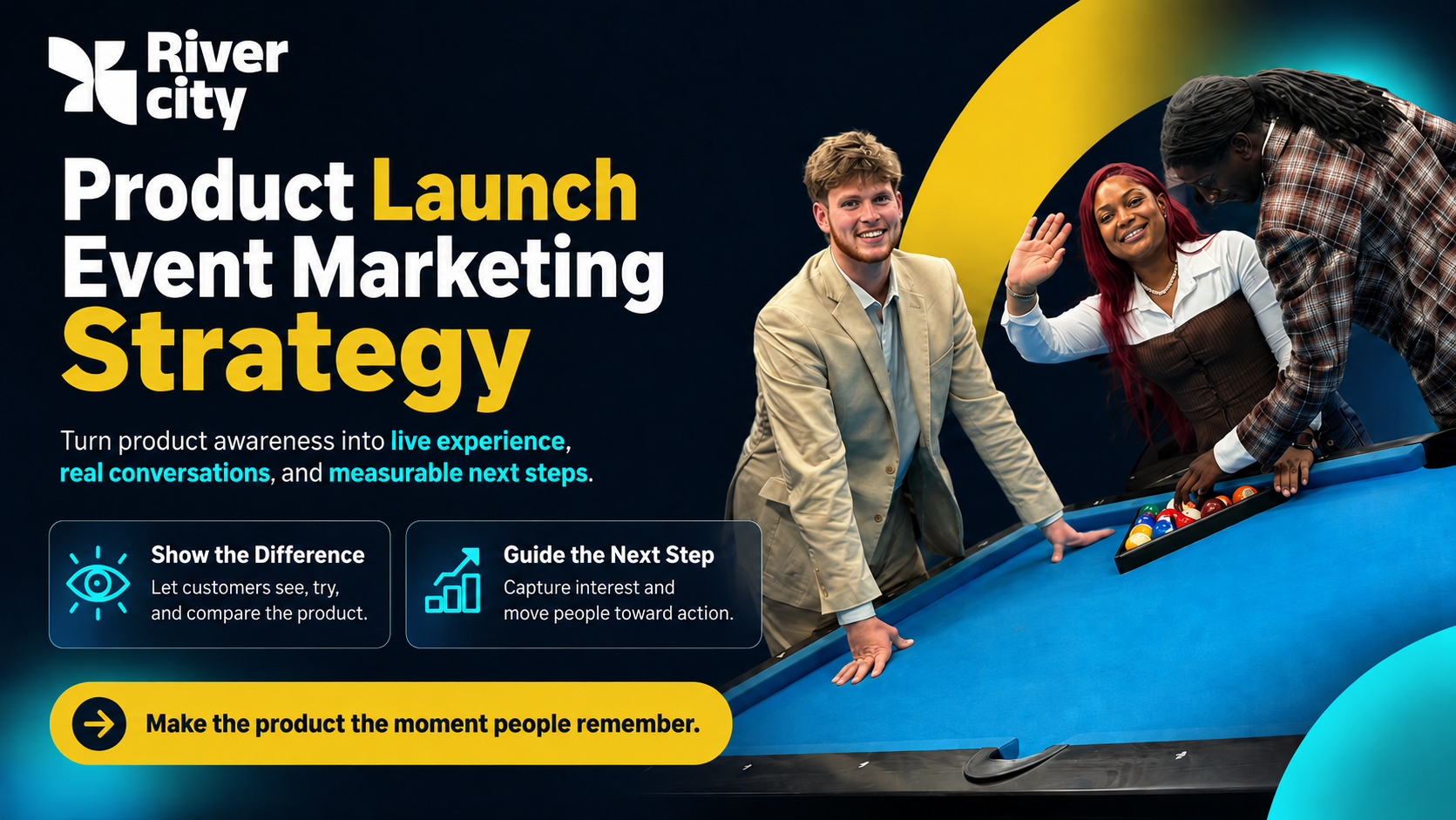
Product launch event marketing gives brands an opportunity to answer those questions in a different way.
Instead of asking customers to imagine the product experience, the brand can create it in front of them.
People can see the product.
Try it.
Ask questions.
Compare it.
Talk about it.
And, when the experience is designed strategically, take a measurable next step.
What Is Product Launch Event Marketing?
Product launch event marketing uses a live experience to introduce a new product or major product update to customers, prospects, partners, media or other relevant audiences.
In experiential marketing, the live component is particularly valuable because the audience can interact directly with the product and the people representing it.
The important point is that a retail or live event should have a defined commercial purpose before the activation is designed.
A launch event should not simply announce:
“Here is our new product.”
It should help the customer understand:
“Here is why this product might matter to you.”
RiverCity’s Live Events service (https://rivercitymontgomery.com/services/) specifically includes product launches and experiential activations, making this type of campaign a natural extension of its broader field marketing capabilities.
Start With the Customer Problem
Brands understandably become excited about features.
The launch team has spent months thinking about the product.
Customers have not.
That creates an important communication gap.
The internal conversation may focus on specifications, functionality, materials, performance improvements or technical innovations.
The customer begins somewhere simpler:
“What does this do for me?”
A strong product launch experience should therefore begin with the customer’s problem rather than the company’s feature list.
The product should still be central.
But the experience needs to translate that product into customer value.
Let People Experience the Difference
Some product advantages are difficult to communicate in advertising.
“Easy to use.”
“Faster.”
“More comfortable.”
“Better quality.”
“More convenient.”
“More intuitive.”
These statements are claims until customers experience them.
A live demonstration turns the claim into evidence.
Instead of saying the product is easy to use, let someone use it.
Instead of describing performance, show it.
Instead of telling people the product is different, allow them to compare.
This is why product launches and sampling activations are naturally suited to experiential marketing.
RiverCity’s live events and pop-up activations (https://rivercitymontgomery.com/services/) can provide the physical environment required to move customers from awareness into hands-on interaction.
Do Not Build the Event Before You Build the Journey
A common planning mistake is starting with production.
Which venue?
What stage?
What lighting?
What signage?
What entertainment?
What giveaways?
All of those decisions can matter.
But they should come after the customer journey.
First determine what the attendee should experience.
They discover the activation.
Something gives them a reason to stop.
A representative starts a conversation.
The customer identifies a relevant need.
They see or try the product.
The representative explains the most relevant benefit.
Questions or objections are addressed.
Interest is captured.
A clear next step is offered.
Now the physical environment can be designed to support that flow.
RiverCity’s campaign process (https://rivercitymontgomery.com/services/) begins with understanding the brand, objectives and markets before determining the right locations, timelines, staffing and execution plan.
Strategy determines what the event needs.
Production brings that strategy to life.
The Product Should Be the Hero
A product launch can easily become overproduced.
Large screens.
Music.
Interactive installations.
Influencers.
Lighting effects.
Elaborate décor.
Those things can generate attention, but there is a simple test worth applying:
When people leave, what do they remember?
The activation?
Or the product?
The best launch environment makes the product easier to understand and more interesting to experience.
The spectacle should support the product rather than compete with it.
Train Representatives Before Customers Arrive
The physical activation attracts people.
The field team determines what happens next.
Representatives need more than enthusiasm.
They should understand:
Who the product is for.
The customer problem it addresses.
The primary benefits.
How demonstrations should work.
Frequently asked questions.
Potential objections.
Competitor comparisons that may arise.
Pricing or offer details.
What claims they can make.
What they should do when they do not know an answer.
What action customers should take next.
RiverCity’s Sales Promoters service (https://rivercitymontgomery.com/services/) focuses on trained representatives who engage customers directly, build connections and support measurable customer acquisition.
That capability becomes particularly valuable during a launch because the product is new and customer understanding is still developing.
Use Questions to Personalize the Demonstration
Not every customer cares about the same feature.
One may care about price.
Another about performance.
Another about convenience.
Another may already use a competitor.
A representative who immediately begins a standard five-minute demonstration may waste time explaining benefits that do not matter to the person in front of them.
A better approach begins with a question.
“What are you currently using?”
“What matters most to you when choosing something like this?”
“What made you want to take a closer look?”
The answer gives the representative a direction.
Now the demonstration can focus on the part of the product that is most relevant.
The experience becomes personalized without requiring complicated technology.
A Launch Event Can Produce Market Intelligence
Product launch events have another advantage that is often overlooked.
They create immediate customer feedback.
Real people interact with a product and start asking questions.
Those questions are data.
Which feature creates the strongest reaction?
What do customers misunderstand?
Which competitor do they mention?
What objection appears repeatedly?
Which benefit gets people interested?
What price questions emerge?
Who appears most interested in the product?
What unexpected use cases do customers describe?
This information can improve marketing long after the event ends.
Website messaging can change.
Sales scripts can improve.
FAQs can expand.
Advertising creative can emphasize different benefits.
Future activations can focus on higher-performing audiences.
Live marketing gives brands access to customer language directly from the field.
Create a Reason to Share the Experience
Product launches can also generate word of mouth.
But customers need something worth discussing.
This does not mean forcing every activation into a social media stunt.
The most shareable part may simply be:
A surprising product result.
A hands-on demonstration.
A before-and-after experience.
A limited first look.
A visually distinctive installation.
A useful personalized result.
The strongest sharing usually happens because the experience gave people something interesting to talk about.
Connect the Launch With Digital Marketing
Experiential marketing and digital marketing do not need to compete.
A product launch becomes stronger when channels reinforce one another.
Before the event, digital marketing can build awareness and invite the right audience.
During the event, QR codes, forms or mobile experiences can capture interest.
Customers may create organic social content.
After the event, paid media can retarget people who engaged.
Email can continue the conversation.
CRM data can route qualified prospects appropriately.
Content generated during the activation can support future campaigns.
The event becomes a high-value touchpoint inside a broader marketing system.
Give Every Interaction a Next Step
One of the easiest ways to waste a strong product experience is ending without a clear call to action.
The customer tries the product.
They like it.
They ask questions.
Then they walk away.
What should have happened?
Depending on the product, the next step might be:
Buy now.
Pre-order.
Claim an introductory offer.
Register interest.
Book a consultation.
Request a larger demonstration.
Receive product information.
Join a waiting list.
Find a nearby retailer.
Share contact details for follow-up.
The call to action should match the complexity of the purchase.
The event’s job is to move the customer to the next logical stage, not force every customer directly to the final stage.
Measure the Product Launch Funnel
Attendance is not enough.
Neither are social impressions.
A commercially focused launch should identify the actions that matter before the event begins.
Those might include:
Meaningful conversations.
Product demonstrations.
Samples distributed.
Trials completed.
Qualified leads.
Pre-orders.
Purchases.
Appointments.
Offer redemptions.
Cost per acquisition.
Customer feedback.
Post-event conversion.
RiverCity’s services (https://rivercitymontgomery.com/services/) include performance tracking and post-campaign reporting, making it possible to evaluate what happens beyond attendance or foot traffic.
Test the Launch Before Scaling It
Brands sometimes want to launch everywhere at once.
That can create enormous attention.
It can also scale problems.
A smaller activation or pilot can reveal:
Which message works.
Which audience responds.
Which questions appear.
Which demonstrations convert.
How long interactions take.
How representatives should be trained.
Where operational friction exists.
What data needs to be captured.
Test the launch experience.
Learn.
Improve.
Then scale.
This approach fits RiverCity’s wider emphasis on building campaigns that can be tested, measured and expanded once performance is proven. Explore its services (https://rivercitymontgomery.com/services/) for more information.
Continue the Conversation After Launch Day
The product may launch on one date.
The customer journey does not.
People who tried the product may need follow-up.
Content from the activation can continue circulating.
Customer questions can become educational material.
High-intent prospects can move to sales.
Feedback can shape subsequent activations.
Successful locations can be repeated.
The launch event becomes the beginning of market momentum rather than a one-night production.
Turn the Product Into an Experience
Modern customers can learn about products almost anywhere.
Search engines.
Social media.
Reviews.
Videos.
Influencers.
Advertisements.
Websites.
What live product launch marketing adds is something different:
Direct experience.
The customer does not only read what the product promises.
They can see what it does.
They can ask why it matters.
They can experience the brand through the people representing it.
And the company can learn from that interaction immediately.
RiverCity develops live events, pop-up activations and field marketing campaigns designed to put brands in front of customers in real-world environments. Explore RiverCity’s services (https://rivercitymontgomery.com/services/), learn more about the company (https://rivercitymontgomery.com/about/), or discuss a future activation directly with the team (https://rivercitymontgomery.com/contact/).
A product launch creates attention.
A well-designed live experience turns that attention into understanding, conversation and measurable action.