
A great live event can create something most marketing channels struggle to generate: a real conversation.
A potential customer stops.
They ask a question.
They explain what they currently use.
They show interest in a product.
They provide their contact information.
Maybe they even say they want to hear more.
Then the event ends.
This is where one of the biggest gaps in event marketing begins.
Many brands invest heavily in creating the interaction and considerably less thought into what should happen after it.
The result is often a database filled with names, email addresses, badge scans or form submissions that gradually lose value because nobody continues the conversation effectively.
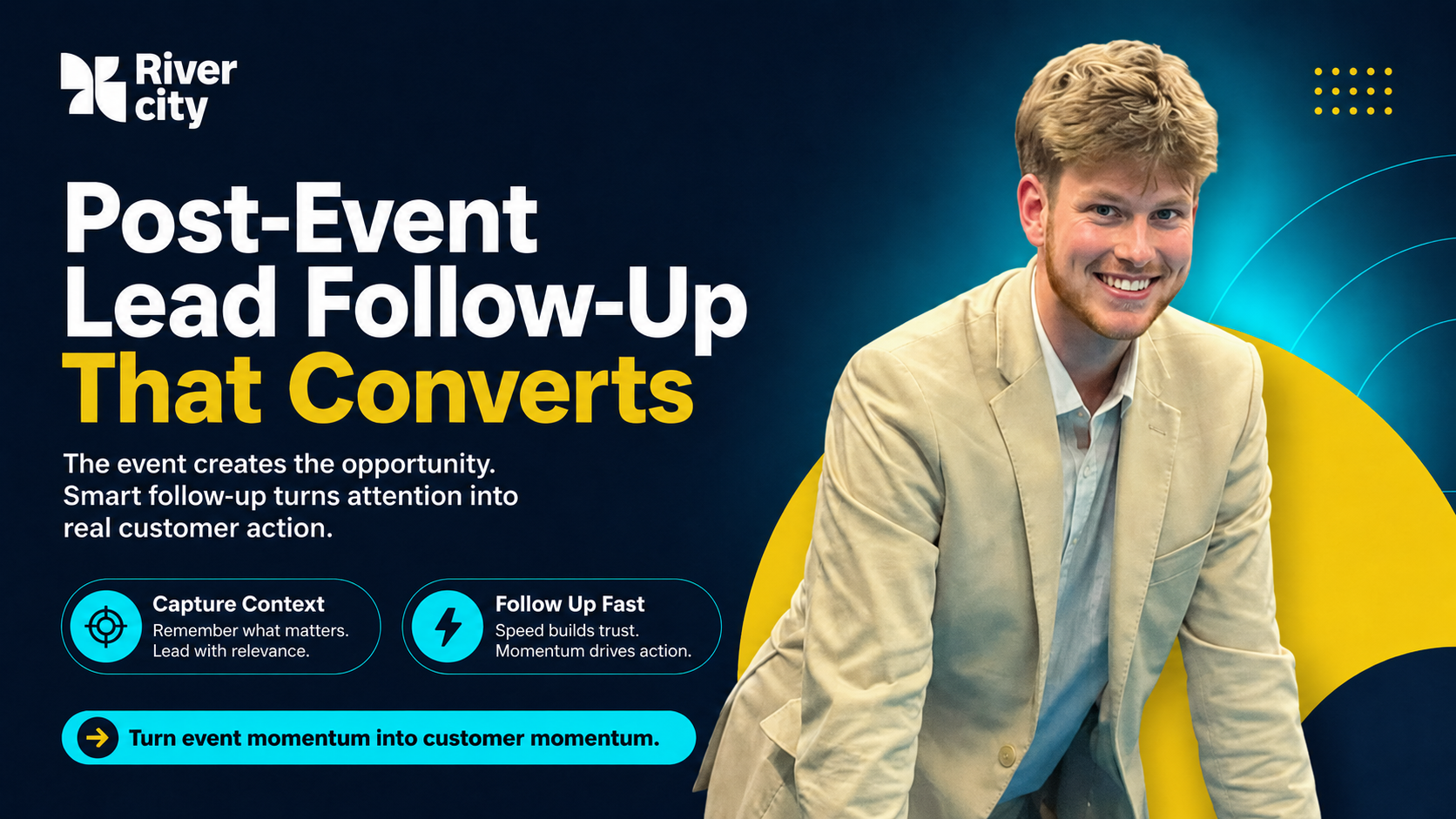
Post-event lead follow-up is what connects live engagement with customer acquisition.
The objective is not simply to send everyone a thank-you email.
It is to preserve the context created during the event and move each relevant prospect toward the next appropriate action.
The Event Is the Beginning of the Sales Conversation
It is easy to think of an event as the campaign itself.
In reality, the event may only be one stage in a much larger customer journey.
Someone might first discover the brand through advertising.
They encounter it again at a pop-up or live activation.
A sales promoter starts a conversation.
The customer asks about an offer.
They provide their details.
Later, they research the company online.
Then another representative follows up.
Eventually they make a decision.
From the customer’s perspective, those are not separate campaigns.
They are interactions with the same brand.
That means the transition from event engagement to sales follow-up should feel continuous.
RiverCity’s live events, pop-up activations and customer acquisition services (https://rivercitymontgomery.com/services/) are built around measurable execution, real-time reporting and scaling what works.
The follow-up process should operate with the same discipline.
Capture Context While the Conversation Is Still Happening
Strong follow-up begins before the event ends.
Imagine a salesperson receives this lead:
Sarah Johnson
sarah@example.com
There is almost no useful context.
Now imagine receiving:
Sarah Johnson
Interested in premium service
Currently uses Competitor A
Main concern: rising monthly cost
Considering switching this quarter
Asked for pricing comparison
The second record changes the follow-up entirely.
The salesperson does not need to begin with:
“Hi Sarah, you visited our event. Would you like to know more?”
They can continue the conversation Sarah already started.
This is why representatives should capture more than contact information when appropriate.
Useful information can include the product discussed, customer need, current provider, major objection, buying timeline, level of interest and agreed next step.
The goal is not to turn every conversation into a lengthy questionnaire.
It is to preserve enough context to make the next interaction useful.
Not Every Event Lead Should Receive the Same Follow-Up
A common mistake is putting every person who interacted with an event into the same email sequence.
The problem is obvious once you consider how different those people can be.
One customer might have said:
“I need this now. Can someone call me tomorrow?”
Another might have said:
“This is interesting. Maybe later this year.”
A third may have provided an email address simply to enter a promotion.
Sending identical follow-up to all three treats completely different signals as if they mean the same thing.
A simple segmentation system is usually enough.
High-intent prospects have clear need, good product fit and an immediate or near-term next step.
Interested prospects fit the audience and demonstrated meaningful interest but need additional information or time.
Nurture prospects may be relevant in the future but have limited current intent.
Low-priority contacts engaged with the activation without demonstrating meaningful buying interest.
Segmentation protects sales time.
It also protects the customer experience.
Follow Up While the Conversation Is Still Fresh
Timing matters because event interactions have momentum.
The customer remembers the representative.
They remember the demonstration.
They remember why they stopped.
That context becomes weaker with every passing day.
Speed, however, should not come at the expense of relevance.
A personalized message sent tomorrow is usually more useful than an automated generic message sent five minutes after the event.
The goal is fast enough to preserve momentum and specific enough to prove that the conversation mattered.
Do Not Send the “Thanks for Stopping By” Email and Call It a Strategy
Most event attendees receive a predictable message afterward.
“Thanks for visiting our booth.”
“Great meeting you.”
“Let us know if you need anything.”
There is nothing inherently wrong with these messages.
The problem is that they often ignore everything the company learned during the live interaction.
A stronger follow-up might say that it was good discussing a specific challenge, acknowledge the product the customer wanted to explore and provide the information or next step that was promised.
The difference is subtle.
One feels like marketing automation.
The other feels like a continuation of a human conversation.
That distinction is especially important for RiverCity because the company focuses on bringing brands in front of real customers through live experiences and direct engagement. You can learn more about RiverCity’s approach (https://rivercitymontgomery.com/about/).
The post-event communication should preserve that human quality.
The Next Step Should Match Customer Intent
Not every event lead should be pushed toward an immediate purchase.
The next action should reflect where that customer actually is.
For one prospect, the right next step could be a sales call.
For another, it might be:
A pricing guide.
A product demonstration.
An appointment.
A trial.
A comparison document.
A consultation.
A future event invitation.
Or simply useful educational content.
The purpose of lead nurturing is not to accelerate everyone artificially.
It is to remove the next relevant barrier to making a decision.
That becomes easier when field representatives document what the customer actually needed.
Give Sales More Than a List
One of the weakest event handoffs sounds like this:
“Here are the leads from the weekend.”
A spreadsheet arrives.
Sales begins working through it from top to bottom.
No prioritization.
No context.
No instructions.
No relationship between the campaign team and the follow-up team.
A stronger process establishes before launch:
Which information will be collected.
What qualifies a high-priority lead.
Who receives those leads.
How quickly follow-up should occur.
Which content should be available.
What happens to prospects who are not sales-ready.
How conversions will eventually be attributed back to the event.
RiverCity’s services (https://rivercitymontgomery.com/services/) already emphasize planning, field execution, measurement and reporting. Connecting the event team with the eventual sales process makes those activities significantly more valuable.
Use Multiple Touchpoints Without Becoming Noise
Not every customer responds to the first email.
That does not automatically mean they are uninterested.
People travel after events.
Their inboxes fill up.
Priorities change.
A follow-up sequence can therefore include several relevant touchpoints over time.
Email may deliver the resource promised during the event.
A salesperson might call a high-intent lead.
LinkedIn may make sense in a B2B setting.
A useful article could answer an objection the customer raised.
Another event could provide a future reason to reconnect.
The important word is relevant.
Repeated generic outreach becomes noise.
Repeated communication that reflects customer interest becomes nurturing.
Measure What Happens After the Event
If an event produced 500 contacts, was it successful?
That number alone cannot answer the question.
What happened to those contacts?
How many were qualified?
How many received follow-up?
How many responded?
How many scheduled conversations?
How many became opportunities?
How many eventually became customers?
What revenue or customer value did the event influence?
This is where post-event follow-up becomes essential to event ROI.
RiverCity’s field marketing and live event services (https://rivercitymontgomery.com/services/) already emphasize performance data and post-campaign reporting.
Extending measurement beyond the live activation makes those reports more commercially meaningful.
Use Follow-Up Results to Improve the Next Campaign
Post-event data should not only prove whether the previous event worked.
It should improve the next one.
Suppose many prospects were interested but needed additional pricing information.
That suggests pricing communication could become part of the next activation.
Suppose leads from one location convert significantly better.
That location or audience may deserve greater investment.
Suppose a particular product demonstration creates unusually high follow-up engagement.
That interaction could become a larger part of the campaign.
Suppose dozens of people provide details but almost none respond afterward.
The campaign may be optimizing for lead capture rather than genuine interest.
Each outcome creates insight.
RiverCity’s broader model is built around understanding campaign goals, executing in the field, measuring results and scaling successful campaigns. Explore its services (https://rivercitymontgomery.com/services/) to see how those elements connect.
Event Follow-Up Is Also Brand Experience
There is another reason to take follow-up seriously.
Customers judge the brand after the event too.
Imagine having an excellent conversation with a representative who promises to send something tomorrow.
Nothing arrives.
Or it arrives three weeks later.
Or the customer receives a generic message that makes it obvious nobody recorded the conversation.
The live experience may have been strong.
The follow-up weakens it.
Customer experience does not stop at the event exit.
Every subsequent interaction either reinforces or reduces the credibility created in person.
Turn Event Momentum Into Customer Momentum
Live marketing creates an opportunity that many brands spend significant money trying to manufacture digitally: someone’s focused attention.
A real person is standing in front of the brand.
They are listening.
Talking.
Asking.
Considering.
That moment should not disappear into a spreadsheet after the activation ends.
The strongest post-event lead follow-up strategies preserve what was learned, prioritize the right prospects, continue conversations quickly and measure what happens next.
RiverCity develops live events, pop-up activations and sales promoter campaigns designed around direct interaction and measurable growth. Explore RiverCity’s services (https://rivercitymontgomery.com/services/), learn more about the company (https://rivercitymontgomery.com/about/), or discuss a future campaign with the team (https://rivercitymontgomery.com/contact/).
A live event creates the opportunity.
Follow-up determines how much of that opportunity becomes business.

One thought on “Post-Event Lead Follow-Up: How to Turn Live Conversations Into Sales”